
Close
Menu
Written by:
Date:
March 19, 2026
Guest Author Samuel Ramani is is an Associate Fellow at the Royal United Services Institute (RUSI) think tank in London and the CEO of Pangea Geopolitical Risk.
On December 2, the UAE-aligned Southern Transitional Council (STC) launched a rapid-fire offensive against government-aligned forces in southern Yemen. The STC’s offensive followed weeks of escalating tensions with Hadhramaut’s Saudi-aligned authorities and resulted in the separatist movement’s swift consolidation of control over the entirety of the former PDRY. While the STC contended that its offensive actions would create a long-term counterterrorism bulwark and advance legitimate cause of south Yemeni self-determination, Saudi Arabia viewed this military campaign as an inexcusable danger to its border security.
These threat perceptions triggered a crisis in the Saudi-UAE bilateral relationship. Saudi Arabia urged the UAE to immediately vacate from its military positions in Yemen. When Abu Dhabi officially complied, the Saudi military proceeded to bomb STC-held positions in Yemen. This military intervention was the first armed confrontation of its kind in the GCC’s history and resulted in the STC’s swift dissolution as a political force. Saudi Arabia was emboldened by this success and viewed Sub-Saharan Africa as the next frontier to outflank the UAE. By outflanking the UAE in Sudan’s gold mining arena and signing a security pact with Somalia, Saudi Arabia dealt severe blows to Abu Dhabi’s multi-year Red Sea littoral power projection vision.
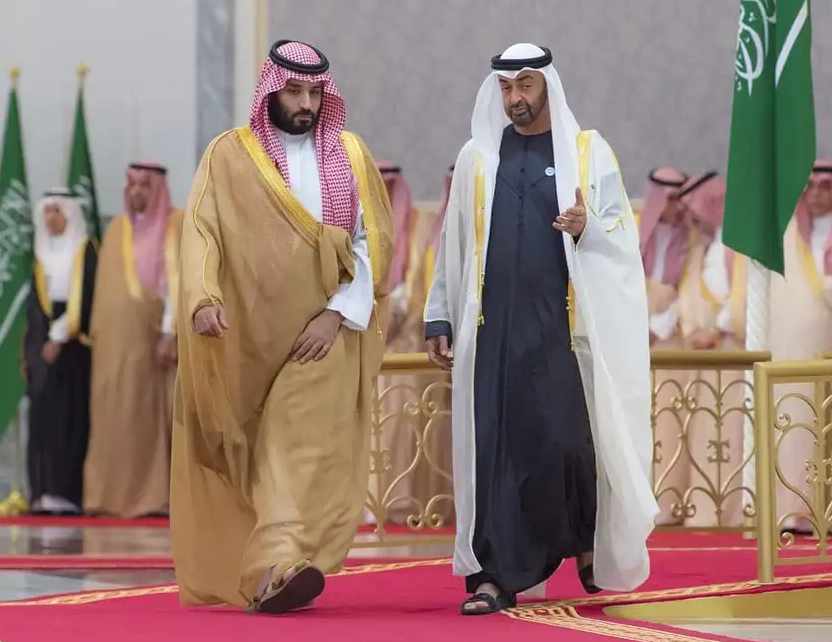
The bad blood engendered by these zero-sum geostrategic power plays was compounded by a vitriolic narrative war. This information war permeated through cable media, X and newspapers of record. Saudi commentators warned of a highly destabilizing Israel-UAE axis and portrayed Abu Dhabi as a disruptive anti-Islamic force. Emirati influencers revived old tropes about Saudi extremism and framed the Kingdom as an enabler of transnational terrorism. Official discourse remained tamer but Saudi-UAE bilateral dialogue froze in late December. It only revived with UAE President Mohammed bin Zayed’s crisis call with Saudi Crown Prince Mohammed bin Salman on February 28, the first day of the U.S.-Israel war with Iran.
Although the Iran War and Tehran’s relentless targeting of GCC economic/military infrastructure has ebbed tensions for the moment, this détente is unlikely to endure for long. Based on my engagements with Saudi and Emirati officials, predictions of a 1-3-year tense period surfaced. While tensions over Yemen were the immediate trigger for the escalation, the rift was triggered by fundamentally divergent visions of the Middle East regional system. This ideational rift has played out at the societal level for decades and intensified even after the 2017 Qatar blockade: a period when rumours were rife that the Saudi-UAE alliance would supersede the GCC.
Saudi Arabia views itself as a hegemonic actor within the GCC that can steer the foreign policy agendas of smaller states. While it aligned with the UAE’s counter-revolutionary approach to the 2011 Arab Spring and shared its disdain for Qatari and Turkish adventurism, it resented Abu Dhabi’s subsequent assertion as a regional power with global geopolitical reach. Saudi Arabia advocates for a “strong state” approach to managing intra-state crises and frames itself as a defender of Arab “statehood.” Saudi Arabia’s robust support for UN-recognized governments in Yemen and Somalia, tolerance for state co-option of Islamist groups and backing of Sudan Armed Forces chief Lieutenant-General Abdel Fattah el-Burhan reflects this line of thinking.
The UAE views Saudi Arabia’s power projection approach as outmoded and a throwback to the immediate post-colonial era when the army was described as the “backbone of the state.” While stopping short of formally recognizing their independence aspirations, the UAE believes that separatist enclaves like the STC and Somaliland can be retooled into counterterrorism bulwarks. The UAE regards grassroots political Islam as more threatening than separatism.
By providing financial muscle to groups with local grievances and using humanitarian aid/security assistance/strategic investments to build entrenched networks, the UAE advances its geopolitical interests and frames itself as a pragmatic actor that works with the region as it is. The UAE is deeply sceptical of the GCC’s efforts to homogenize the Arabian Peninsula’s foreign policy and rejects Saudi Arabia’s efforts to impose its will on its smaller neighbours. Before the Iran War, Emirati officials privately opined that low oil prices, failures at Vision 2030’s flagship NEOM project and burdensome financial commitments to Yemen/Somalia/Sudan/Pakistan/Egypt would force Mohammed bin Salman to buckle under the pressure of overreach.
As the drivers of Saudi-UAE contestation are seemingly irreconcilable, the rift will remain multi-faceted. The UAE’s enduring economic normalization with Israel clashes with Saudi Arabia’s emphatic post-October 7 resistance to the Abraham Accords. As the Emirati foreign policy community muses about a post-Iran Middle East and sees Israel-Turkey tensions as profoundly disruptive, MBS is repairing his once-fractious relationship with Turkish President Recep Tayyip Erdogan. As Saudi mining giant Maaden seeks to complement domestic rare earth reserves with African mineral supply chains and challenge the UAE’s renewable energy investments in Africa, a critical mineral rivalry is afoot. This sphere of contestation will inevitably extend to the AI domain as well as the competition for advanced U.S. chips.
Nonetheless, there are also factors that will restrain its scope and prevent the rift from becoming as deep as the 2017-21 Qatar crisis. Saudi Arabia and the UAE have a vested interest in maintaining OPEC+. The Iran War could scupper sovereign fund adventurism in Africa and could promote greater economic interdependence. Saudi Arabia’s scrapping of the Riyadh HQ mandate foreshadowed this trend and eased tensions with the Dubai business community.
While Saudi Arabia’s vision commands more regional support, it has not been able to pull other GCC countries like Kuwait and Bahrain to its side or polarize the regional order against Abu Dhabi. Although Emiratis fume at President Donald Trump’s alleged openness to MBS’s push for anti-UAE sanctions over Sudan, they know the U.S. and other great powers do not want this rift to escalate out of control. Geo-economic statecraft is likely to be the principal instrument of Saudi-UAE competition and caustic rhetoric in the information space of both countries is likely to be channelled to highly funded lobbying campaigns in major capitals.
In summary, the Saudi-UAE rift has deep systemic drivers and is likely to remain an enduring feature of the regional system. Even though it commanded more attention in Riyadh and Abu Dhabi in February than the impending war with Iran, it will not be a centrifugal rivalry that tears the Arabian Peninsula and Gulf security to its seams.

UK Information Commissioners Office Registration Number: ZA427383
CR Investigations Ltd Company Number 08003102
© 2026 CR Investigations Ltd
Designed by The Sourdough